Hunu
Telemedicine app for rural vision screening and eye care access
Overview
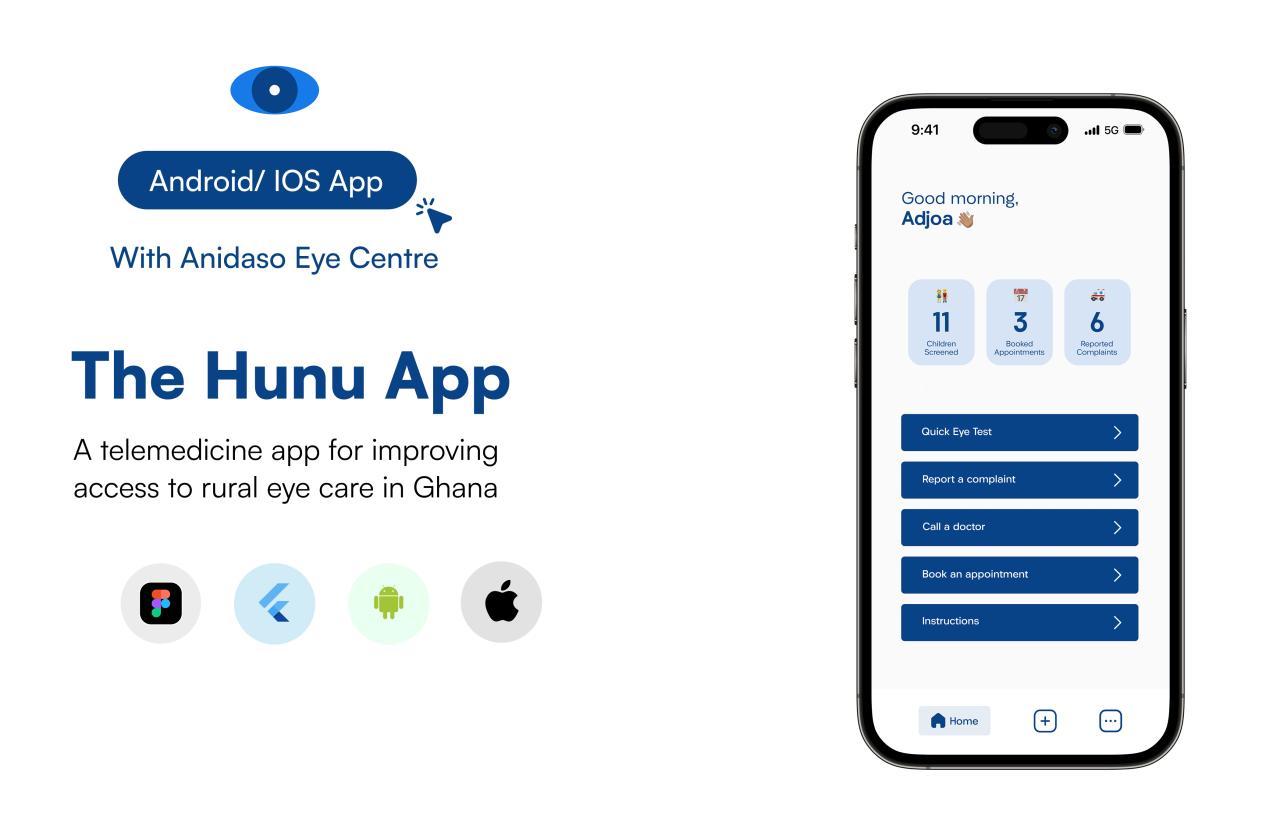
Hunu is a mobile telemedicine application built for Anidaso Eye Centre to extend eye care access into rural communities in Ghana. The app enables non-clinicians — community health workers, trained volunteers — to conduct standardized visual acuity tests and submit results to remote optometrists for review.
The name “Hunu” means “to see” in Fante, one of Ghana’s regional languages.
The Problem
Rural access to eye care in Ghana remains severely limited. Most optometrists are concentrated in urban centers; patients in smaller towns and villages may go years without a basic eye examination. The consequence is preventable vision loss — from uncorrected refractive errors, undetected glaucoma, and manageable conditions that progress due to late diagnosis.
Hunu was built to create a pathway: bring a standardized screening tool to where patients already are, and connect the results to a clinician who can review and recommend follow-up.
How It Works
Community health workers use the Hunu app to:
- Register patients — basic demographic intake
- Administer visual acuity tests — standardized charts adapted for on-screen delivery, usable without a trained clinician present
- Submit results — test data is transmitted to a remote optometrist dashboard for review
- Receive recommendations — the reviewing clinician flags cases requiring in-person follow-up and generates referral letters within the app
The design prioritizes simplicity for the operator — the interface guides non-clinicians through each step with minimal room for error.
My Role
As Project Manager and Software Engineer at Anidaso Eye Centre, I was responsible for both the technical build (Flutter mobile app, Firebase backend) and the operational design — determining which tests could be standardized for non-clinical administration and what the handoff protocol between field worker and remote clinician should look like.
Outcome
Hunu enabled Anidaso to extend screening capacity beyond the clinic’s immediate catchment area. The project demonstrated that structured, low-cost telemedicine can be a practical tool for eye care access in resource-limited settings — a model relevant across much of sub-Saharan Africa.